
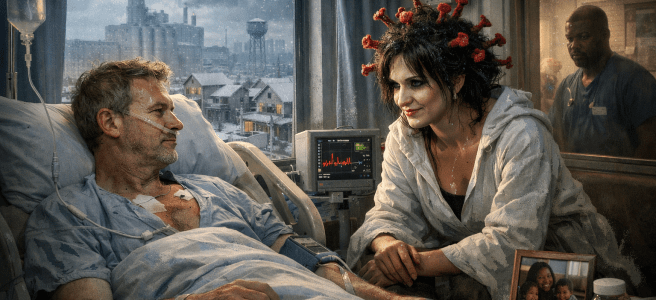
Während Donald in Israel das neue Golfresort plant, geht alles andere seinen Gang. Hier im Krankenhaus. Hier mit einer neuen Corona Generation. Wer interessiert sich für Donald? Für seine Vorlieben und Ein- Stellungen? Wo das Leben ist, riecht das Zimmer gesund nach Desinfektionsmitteln und abgestandenem Kaffee. Was noch? Monitorpiepen, das gleichmäßige Zischen von Sauerstoff, irgendwo auf dem Flur flucht ein Pfleger leise vor sich hin. Ich liege da mit aufgesägtem Brustbein, frischer Narbe, frisch repariertem Herzen – wieder einmal – und einer Krebsdiagnose, die sich anfühlt wie ein schlechter Witz mit Pointe aus Stahl.
Draußen schneit es über Buffalo. Der Wind vom Lake Erie pfeift gegen die Scheiben wie ein beleidigter Gott.
Und dann sitzt sie plötzlich da.
Corona.
Nicht als Virus, nicht als Grafik aus den Nachrichten, sondern als Frau mit zu großen Augen und einem Mantel, der aussieht wie aus Krankenhauslaken genäht. Ihre Stimme kratzt wie trockener Husten.
„Na“, sagt sie, „wir zwei schon wieder.“
Ich drehe den Kopf ein Stück. „Du hast ein Talent für Timing.“
Sie lächelt schief. „Du auch. Herzinfarkt während einer Krebsdiagnose – das ist fast schon Performancekunst.“
„Fick dich.“
„Oh, ich ficke niemanden“, sagt sie ruhig. „Ich decke nur auf.“
Draußen schiebt sich ein Schneepflug durch die Straße. Buffalo im Winter ist wie Amerika im Dauerzustand: hart, weiß, laut und immer kurz davor, im Eis stecken zu bleiben.
„Weißt du“, sagt sie und rückt näher an mein Bett, „in Buffalo haben sie gemerkt, was ich wirklich bin.“
„Ein Virus.“
„Nein. Ein Scheinwerfer.“
Sie lehnt sich zurück. „Ich habe nur beleuchtet, was längst da war. Die Familien im East Side-Viertel, schwarz, arm, drei Jobs, kein Krankenversicherungsschutz. Und die Familien draußen in den Vororten, weiß gestrichene Zäune, Homeoffice, Aktienportfolios, Sauerteigbrot.“
Ich lache trocken, was sofort wehtut. „Du willst mir erzählen, du bist sozialkritisch?“
„Ich bin konsequent“, sagt sie. „Ich gehe dorthin, wo Menschen eng sind. Wo sie Bus fahren müssen. Wo sie in Pflegeheimen arbeiten, in Schlachthöfen, in Krankenhäusern wie diesem.“
Sie tippt gegen meine Infusionsleitung. „Reichtum kann Abstand kaufen. Armut nicht.“
Ich denke an Jane Walker. Jane mit den dünnen Handgelenken und den immer zu großen Träumen. Jane, die immer die schlimmsten Karten zieht. Kranker Vater, Schulden, ein Mann, der schneller verschwand als das Geld auf dem Konto. Und dann ich, hier, operiert, wiederbelebt, während sie irgendwo Rechnungen sortiert.
„Warum kriegen manche die tollen Ehepartner“, murmele ich, „die sicheren Häuser, die gesunden Gene – und andere nicht?“
Corona zuckt mit den Schultern. „Weil Amerika nie gerecht verteilt hat. Nicht Liebe, nicht Geld, nicht Luft.“
„Jetzt klingst du wie eine Soziologie-Professorin.“
„Vielleicht bin ich das“, sagt sie. „Oder vielleicht bin ich nur das Echo von Jahrhunderten. Sklaverei, Redlining, Hypotheken, die nur in bestimmten Vierteln genehmigt werden. Schulen, die von Grundsteuern leben. Reichtum, der vererbt wird wie ein Familienrezept.“
Sie beugt sich vor. „Weißt du, was der wahre Unterschied zwischen schwarz und weiß in diesem Land ist?“
„Sag’s mir.“
„Fehler.“
Ich runzle die Stirn.
„Weiße Familien dürfen Fehler machen“, fährt sie fort. „Ein missglücktes Studium, eine gescheiterte Firma, eine Sucht. Schau Dir Donald an. Das Gegenteil funktioniert auch. J.D. ist ein Beispiel. Ein Film im Film . Es gibt oft ein Netz. Elternhaus. Erspartes. Gestolenes. Kontakte. Schwarze Familien? Ein Fehler kann alles kippen. Kein Netz. Nur Beton.“
Das Piepen meines Monitors beschleunigt sich ein wenig.
„Und du?“ frage ich. „Warum ich? Krebs, Herz, du auf Besuch?“
Sie sieht mich lange an. „Weil dein Körper auch Amerika ist.“
„Ach, jetzt wird’s pathetisch.“
„Nein. Realistisch. Dein Herzinfarkt – Stress. Dein Krebs – vielleicht Pech, vielleicht Umwelt, vielleicht Jahre von Druck. Du hast gearbeitet, gekämpft, getragen. Für wen? Für welche Familie? Für welches Bild von Erfolg?“
Ich schweige.
„Du glaubst, du bist hier nur wegen Biologie“, sagt sie leise. „Aber dein Herz hat Jahrzehnte von Erwartungen geschluckt. Stark sein. Funktionieren. Nicht jammern. Vor allem nicht als Mann. Vor allem nicht als jemand, der sich mit Leuten wie Jane Walker solidarisch fühlt, aber trotzdem im System mitspielt.“
„Du gibst mir also die Schuld?“
„Nein“, sagt sie. „Ich gebe niemandem die Schuld. Ich bin nur die Rechnung.“
Der Wind heult gegen die Scheibe. Buffalo ist ein rostiger Traum aus Stahl und Schnee. Fabriken, die dichtgemacht haben. Familien, die geblieben sind. Schwarze Nachbarschaften, die nie die Kredite bekamen. Weiße Viertel, die vom Erbe leben.
„Weißt du“, sage ich nach einer Weile, „Jane trifft es immer am härtesten. Leute wie sie. Immer die schlimmsten Opfer.“
Corona nickt. „Weil sie näher am Abgrund leben. Wenn ich komme, stoße ich nur leicht.“
„Und die anderen?“
„Die rutschen ein Stück. Verlieren vielleicht Geld. Vielleicht Ansehen. Aber sie fallen selten ganz.“
Ich starre an die Decke. „Also was jetzt?“
„Jetzt?“ Sie steht auf. „Jetzt heilst du. Oder du stirbst. Wie immer.“
„Das ist alles?“
Sie geht zur Tür, dreht sich noch einmal um. „Nein. Das ist der biologische Teil.“
„Und der andere?“
„Der andere“, sagt sie, „ist die Frage, was du tust, wenn du hier rauskommst. Bleibst du Teil der Maschine, die Jane Walker zermahlt? Oder brichst du irgendwo ein Zahnrad heraus?“
Sie lächelt – kein freundliches Lächeln, eher ein wissendes.
„Ich komme nicht nur, um zu zerstören“, sagt sie. „Ich komme, um sichtbar zu machen.“
Die Tür schwingt auf. Ein echter Pfleger tritt ein, müde Augen, dunkle Haut, Akzent aus dem Süden. Er prüft meine Werte, richtet die Decke.
Corona ist verschwunden.
Draußen fällt weiter Schnee auf Buffalo. Weiß über Schwarz, kalt über warm, reich über arm. Aber unter allem pulsiert etwas. Ein Herz.
Corona bei den Hillbillies
 Begegnungen/Encounters