Oh, How Beautiful Greenland Is
It was one of those memorable days when the sun painted a blood-red promise across the sky and the mansions of the wealthy in Hollywood burned, as Donald Trump decided to shatter the political china. The plan to annex the Panama Canal Zone, Canada, and Greenland was like a fatal melody that refused to fade from his mind. With a determination more akin to a child’s impulse than a statesman’s calculation, he declared his intent to bring these territories under American control. „Why shouldn’t we rule the world too?“ he mused, as always addressing an invisible audience, striding through the halls of the White House.
But no sooner had his ambitions thrown the world into turmoil than the United Nations convened—a collective of nations whose patience had long been tested. Resistance mounted. It was not just a political maneuver but also a profoundly practical challenge: Trump wanted to smash porcelain that had stood on the shelves of diplomacy for generations. In response to the united opposition to the annexations, the president entered the scene like the last piece of a puzzle that could never be completed.
The reaction was as monumental as the politics behind it. In an act of near-comedic hubris, Trump, the „Don“ of the modern age, shattered all the china in the White House. It began with a single dish—a plate of the finest porcelain, which he smashed to the ground as a symbol of the fragile world order he sought to outwit. The shards flew in all directions, accompanied by a triumphant smile that betrayed neither joy nor regret.
“No more cutlery!” he proclaimed with a broad grin. “From now on, we eat like real winners. Hands, people. Hands!” The old rituals were over. From then on, no one in the White House would dine with utensils, and all other formalities of fine dining were abolished. Trump was turning the entire political culture upside down—just as he always had.
The Great Feast
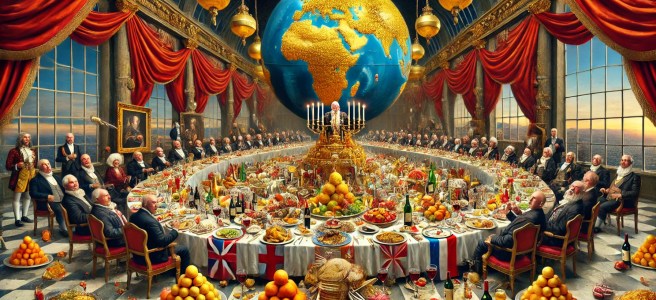
To celebrate the occasion, he invited the greatest minds of the business world: Mark Zuckerberg, Elon Musk, Jeff Bezos, and other billionaires whose names had long become synonymous with global influence. They were not just to come as guests but as players in an absurd theatrical production that Trump directed—the theater of food.
The tables were lavishly set, though not with the kind of fare one might expect at an opulent state banquet. Instead, there were vegetables and porridge—green leaves as tasteless as the political conflict Trump had ignited across the world, and porridge that oozed beyond the rims of the plates in a thick, sticky mass. Only for Trump himself were an extra-thick burger and a large pizza served—the true taste of America.
“This is real luxury,” Trump murmured as he bit into his burger, while the billionaires looked on with a mixture of horror and unease. At first, they held back, trying to preserve a shred of civilization’s decorum. They clung to their forks as though grasping at a world order that was rapidly unraveling.
But it didn’t take long for the atmosphere to change. One by one, the billionaires reached into the porridge with their bare hands, smearing their cheeks or rubbing the sticky mass into their fingers as if discovering a new, almost liberating ritual. Zuckerberg, initially hesitant, suddenly grabbed a carrot and held it triumphantly aloft. “The world is changing, and we’re changing with it,” he declared with a grin only half-tinged with sincerity.
Elon Musk, who had been staring critically at the white porridge, finally grabbed a handful of vegetables and flung it toward Jeff Bezos, who instinctively caught it, only to take a massive bite and join in. A splash of tomato porridge landed on Musk’s shirt. “What a fantastic mess,” he said. “Entirely in Trump’s style.”
And so the game began: a surreal parade of supporters and opponents of the annexations. Each billionaire adopted a role in this absurd dinner theater. Zuckerberg suddenly proclaimed himself a supporter of the Greenland annexation, while Musk, who had initially seemed aloof, now railed vehemently against the takeover of Canada. The others followed suit, navigating the political turmoil through porridge and their greasy hands.
Finally, as the wine flowed freely and the porridge spread inexorably across the billionaires’ shirts, there was a moment of pause. This was no longer just a meal; it was a symbol—a symbolic act in which the world they had controlled for so long slipped from their grasp before their eyes, in a farce that respected neither political decisions nor moral boundaries. And as Trump reached for one last burger, he paused for a moment of contemplation.
“Maybe just one more piece of Greenland?” he murmured thoughtfully, as another splatter of porridge marked the loss of composure in the room.
The ending remained unclear, but the billionaires continued feeding each other, sometimes earnestly, sometimes laughing, leaving the question hanging: Would the porridge and chaos flow on until nothing remained, or would someone eventually pick up the first plate and sweep up the shards?
 Begegnungen/Encounters